
Lightning Jazz
Playing All Night 'Til the Ideas Run Out

“One thing I like about jazz, kid, is that I don’t know what’s going to happen next.” — attributed to Bix Beiderbecke.
I hate lectures. I refuse to waste my one wild precious life watching a presenter fumble with what to say about slide seven. When I’m bringing together a group of cool people to talk about something, what I want is to get the ideas out of everybody’s heads and into the room, bumping into each other.1
Unfortunately, when it comes to intellectual gatherings, we lack the techniques to do this well. Two methods that are frequently tried fall short.
Lightning talks don’t promote interaction, and they force a stilted presentational format. People “try to give a talk” instead of just saying what they want to say.
Small group discussions get held hostage by the least conversationally skilled participant, splinter the event into factions, and offer no graceful way to leave one group for another.
But I come with good news: there’s a better way! Lightning jazz - created by Elizabeth Garrett (who’s been frustrated with the above) - takes the many-individual-talks format of lightning talks and blends it with the interactivity and freeform riffing of good conversation. When done well, it elicits and weaves together the knowledge and perspectives of the participants in an alive, fast-paced manner.
I use this when I run workshops and have suggested it at others I’ve attended, to great success.
Setup:
Group size: works from about 5 to 35 people.
Setup: a whiteboard (or big paper) at the front, markers, chairs loosely facing it, preferably not in deep rows
Duration: people can do this for a very long time. I suggest starting with a 35-minute to 1-hour container.
Facilitation: like everything good, having someone on the ball of making sure this goes well is a lot of it.
How to play Lightning Jazz
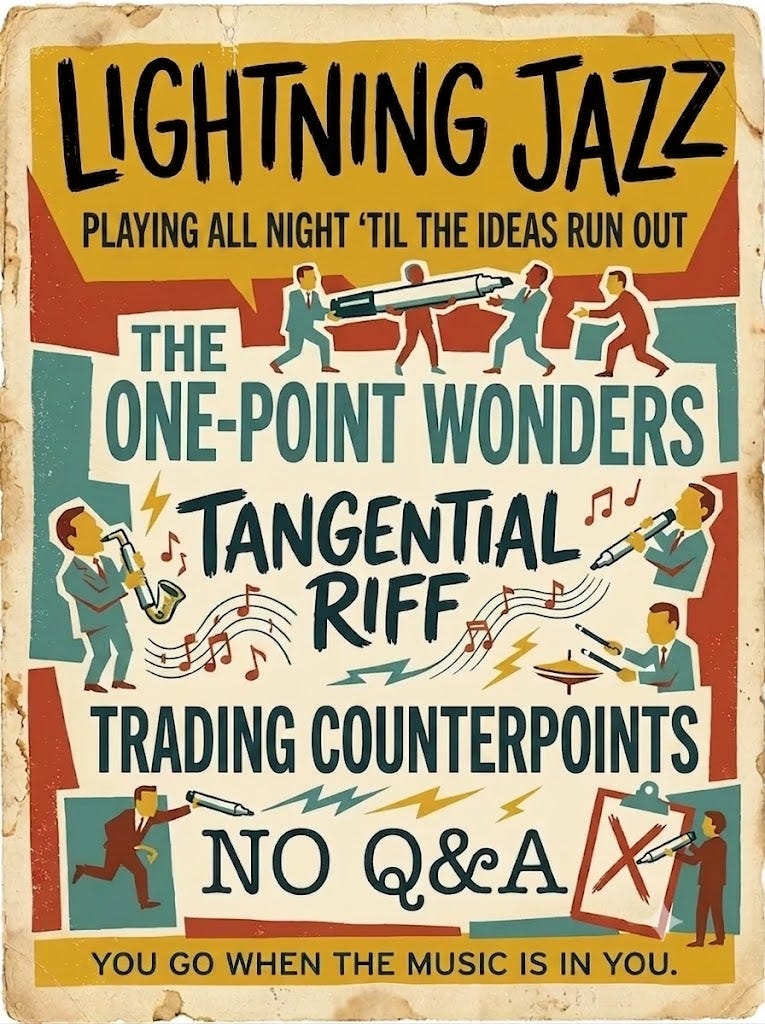
There is one rule of lightning jazz - if you want to talk, you need to pick up a pen and stand at the whiteboard.
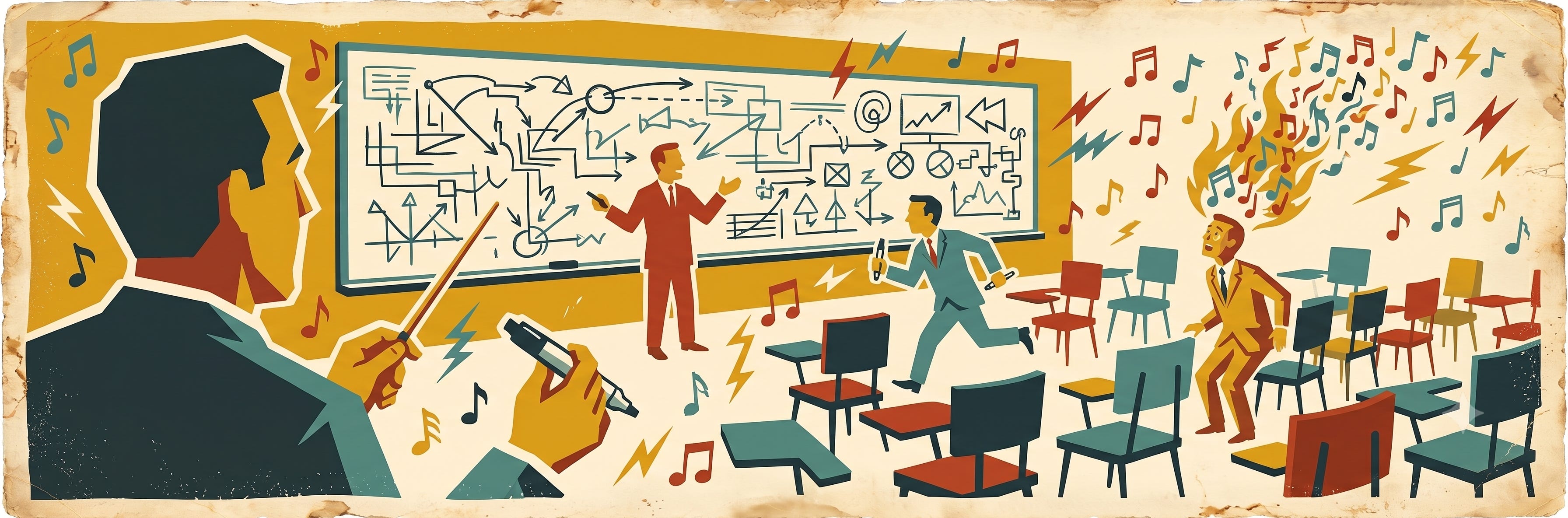
The facilitator gives the topic (generally quite broad, e.g., “making good evals”, “How is consciousness tricky”, “courage”). They ask everyone to think about what talk they would give if they were to give one, then sets a 3-minute timer. When the timer finishes, it is time to begin. Someone stands up at the board, holding a pen, and starts saying what they want to say to the group - this is the beginning of the jazz. Whiteboarding is encouraged.
You know who goes next because they’ll get up and go. They’ll be the one with the music (fire, need, Quaker inspiration) in them. They’ll want to come to the front and say something. Implicit in this is that there’s no ordering.
When they finish, someone else comes up and gives their own jazz notes. It might extend the last one. Cool. It might riff off it, or move to a different topic. Also cool. It might be a brutal takedown of the entire frame and premise. Now we’re making jazz.
There’s no Q&A. If you have a question, or want an earlier presenter to clarify something, come up and jazz on it. If it’s a point of quick clarification, I suggest getting to the board quickly, so the last person hasn’t gone all the way back to their seat.
Like all good shows, there’s a bandleader (aka the facilitator), setting the tempo and handling the arrangements. They track how the session is going and push it toward aliveness, by their lights, which means they can cut off threads (or people), and prompt others to come up and join the show.
My understanding of Jazz - largely downstream of La La Land - is that in the best jazz you don’t even wait for the first musician to finish, you jump in with your own tune when you feel it’s right. So you might see people walk up front early, while someone is still speaking, because they know exactly what needs to be said next. And of course, it doesn’t mean the presenter has to give up the spot! It tends to get worked out; the facilitator can arbitrate.
Tips for facilitators
Bookmarks - if it seems like a few people have taken the jazz too far down a rabbit hole no one else is really following, or have found a point of contention that will take a while to resolve, have a sheet up to the side and write the thing down as a “bookmark” to come back to at a different point.
The no-Q&A rule is the one I see broken most. Q&A pulls the room back into presenter-and-audience mode. If it’s worth asking, it’s worth presenting. Maybe you give a little wiggle room for a shouted-out “hey, what was that word you said?” but that’s about it. I suggest being pretty firm.
A person can give five jazzes; a person can give zero. Two people can jazz back and forth at each other until a third jumps in and says, “Wait, you’re both missing the point entirely.” There is only one rule, but it’s up to the facilitator to, in various ways, make it work for the specific group as a whole.
Encourage whiteboarding because it helps people refer to the ideas from previous speakers and makes new concepts common knowledge. Having a visual record of the jazz is great later for jogging memory.
It’s nice to have an experienced facilitator, but I don’t think it’s necessary. The way to be a good one is to check whether you find a thread interesting and whether the group seems to.
I’ve tried to describe how to do lightning jazz, but describing how this should work is less effective than modeling the behavior you want to see. If people seem stuck in the lightning talk mindset, try jumping in (if there is something alive in you) and doing something different early on - ask a question to the group, make an observation, suggest a term.
Try it at your next workshop or Bay Area house party.
Which is, as we all know, how new ideas are made.
wild that we're converging on the importance of the same problem: methods for having better meetings/conferences
Love it. What was the topic of the best Lightning Jazz you ever witnessed?
Hope to go a Bay Area house party featuring one of these sometime!